CLARA available beginning 2027. Reduced pricing tiers available for pre-orders.
Now more than ever.
We need something inexpensive.
Simple to train. Easy to scale.
Clara Setup: A tabletop pump connects to a filtration cartridge that is submerged in unfiltered water.
Take a
closer look.
0.1 micron
Hollow fiber filtration
One button
Clean water immediately
USB charged
Minimal electricity required
Simple set up
No tools needed
Large volume
For large households
Weekly maintenancе
Backflush with the supplied syringe
Where Clara excels.
Where it doesn't.
Where Clara excels
- Immediate water : Clean water as soon as you press the button. There's no waiting for a batch to filter.
- Large household volumes : Designed to provide water for larger households, without having to wait between small batches.
- Simple to power : The pump is USB charged, so access to a phone-charging source is all the electricity the user needs.
- Simple to use : Fill the container, place the cartridge in the water, press the button. That's it.
Where it doesn't, we tell you
- Pesticides and herbicides : Clara does not block these, so it is not the right solution when they are the concern.
- Fully off-grid use : The pump needs to be charged, so Clara needs access to electricity.
- Loose parts : The pump, tube and cartridge are separate pieces, so some loss should be expected.
- Cartridge replacement : For best practices, replace the cartridge once a year, Irreversible biofouling can occur in the field.
Distribution and training
We believe implementation should be as straightforward as
possible.
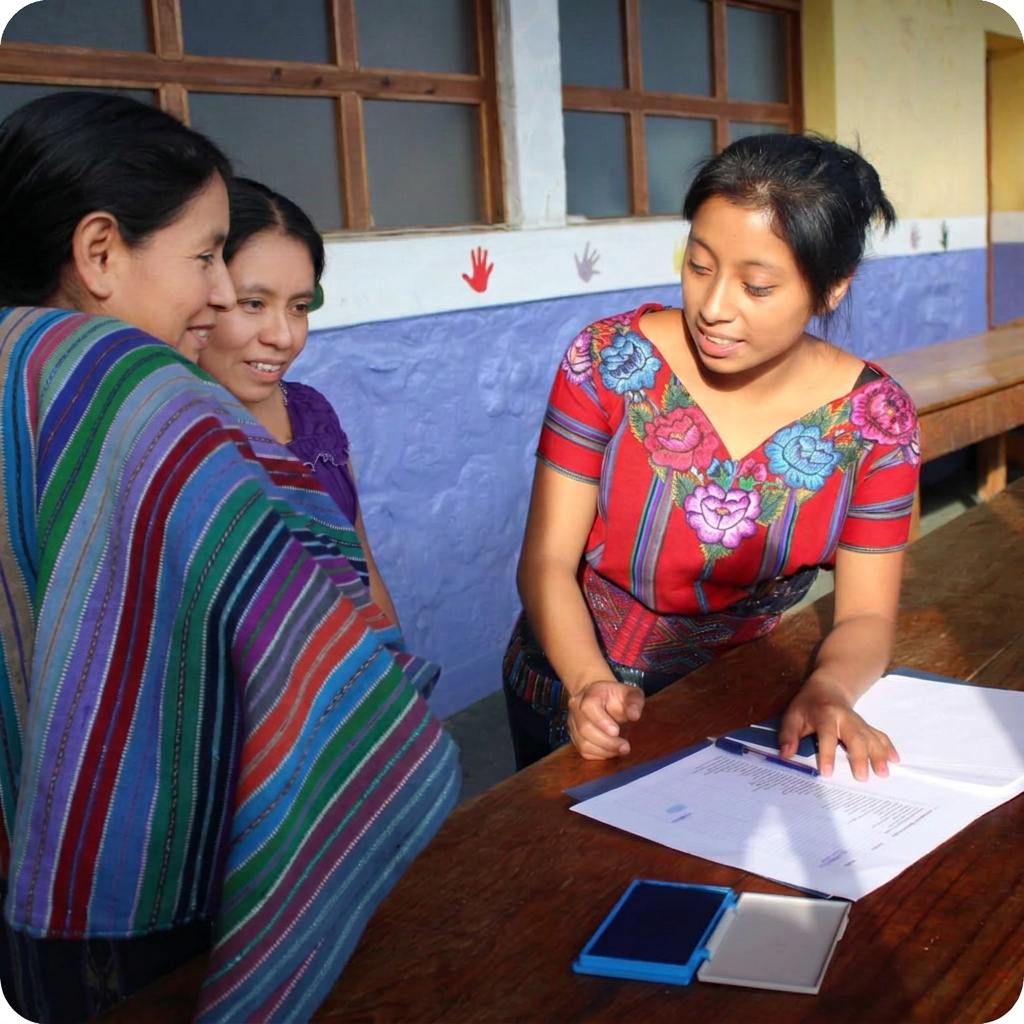
In distribution settings, a one-on-one filter training takes
approximately 10 minutes. For groups, we recommend an
optimal demonstration length of around 30 minutes.
To support implementation, we provide field-tested
demonstration scripts, guidance for common questions and
issues, and clear instructions for trainers and users.
What’s in the box.
Pump
Small USB-charged electric pump.
Tube
Connects the pump to the cartridge.
Filter cartridge
0.1 micron hollow fiber filtration.
Syringe
For backflushing.
USB cable
For charging.
$23 USD per unit
$11 USD per replacement cartridge
$11 USD per replacement cartridge
Our Design Logic
Clara is designed around the realities of climate disruption, changing water contexts, and difficult logistics.
Clara’s compact size reduces the burden of moving equipment through rural and crisis-affected areas, its low cost makes larger distributions possible, and it produces water immediately rather than requiring a batch to fill and wait.
These differences can be critical when time, transport, and resources are constrained.🙂🙂
Clara’s compact size reduces the burden of moving equipment through rural and crisis-affected areas, its low cost makes larger distributions possible, and it produces water immediately rather than requiring a batch to fill and wait.
These differences can be critical when time, transport, and resources are constrained.🙂🙂
Elizabeth, Founder

Frequently asked questions
What pathogens and contaminants does Clara remove?
Clara uses a 0.1-micron absolute hollow-fiber membrane to remove 99.99999% (Log 7) of bacteria and 99.9999% (Log 6) of protozoa, including E. coli, cholera, Salmonella, Giardia, and Cryptosporidium. Clara removes 100% of microplastics, as well as suspended solids and helminth eggs.
Clara does not remove viruses, pesticides, herbicides, or other dissolved chemicals.
Is there a minimum order?
No. There’s no minimum order. You can order the number of units that makes sense for your program.
Shipping is separate, and larger quantities generally make shipping more economical. We’ll always work with you to find the most inexpensive shipping option we can.
Shipping is separate, and larger quantities generally make shipping more economical. We’ll always work with you to find the most inexpensive shipping option we can.
Where does Clara ship from?
Clara ships from Antigua, Guatemala.
Can I order replacement parts? What if a part gets lost?
Yes. Replacement parts are available.
The pump, tube and cartridge are separate pieces, so some
loss should be expected across households..
Do you provide demonstration or training materials?
Yes. We provide demonstration scripts and best practices for community priming, as wellas guidance around frequently observed questions from staff.
The goal is to make introducing Clara into a community as straightforward as possible.
The goal is to make introducing Clara into a community as straightforward as possible.
How often does the filter need to be backflushed?
The cartridge should be backflushed once a week.
Backflushing pushes filtered water back through the cartridge to remove accumulated debris and bacteria.
To backflush:
Fill a glass with filtered water and remove the cartridge from the tube.
Fill the supplied syringe with filtered water, attach it to the cartridge nozzle, and slowly push water through the cartridge. Repeat once. Reconnect the cartridge securely and place it back in the water.
To backflush:
Fill a glass with filtered water and remove the cartridge from the tube.
Fill the supplied syringe with filtered water, attach it to the cartridge nozzle, and slowly push water through the cartridge. Repeat once. Reconnect the cartridge securely and place it back in the water.
Why does the cartridge need to be replaced every year?
Laboratory conditions are different from field realities. In real-world use, irreversible biofouling can occur.
A one-year replacement interval is the most conservative and safest approach.
This is particularly relevant in Guatemala, where water can have high sediment loads due to volcanic ash in soil and surface water, as well as high levels of microplastics.
A one-year replacement interval is the most conservative and safest approach.
This is particularly relevant in Guatemala, where water can have high sediment loads due to volcanic ash in soil and surface water, as well as high levels of microplastics.
Can Clara be used for a large household or group?
Yes. Unlike drip filtration, Clara does not require water to pass through the filter slowly over time. This makes it particularly useful when many people depend on the same water source, including during response periods when there may not yet be enough filters for individual households.
Clara can also serve shared settings such as distribution points, schools, shops, and small cottage industries.
How often does Clara need to be charged?
Clara typically needs to be charged every few days, depending on how frequently and how long it is used. A full charge takes a couple of hours.
When the battery is running low, the pump will begin to operate more slowly, indicating that it is time to charge.
Clara is designed around the realities of rural electricity access: anyone with access to phone charging has enough electricity to operate the system.
Even where homes do not have electricity, phones are commonly charged at shops and other community locations.
Fill Bucket.Press button. Clean Water
Legal
- Privacy policy
- Legal notice
© 2026 Clara· Based in Guatemala 🇬🇹 · Distributed internationally